Full and final settlement
Settle every leaver in one figure,
on the two-day clock
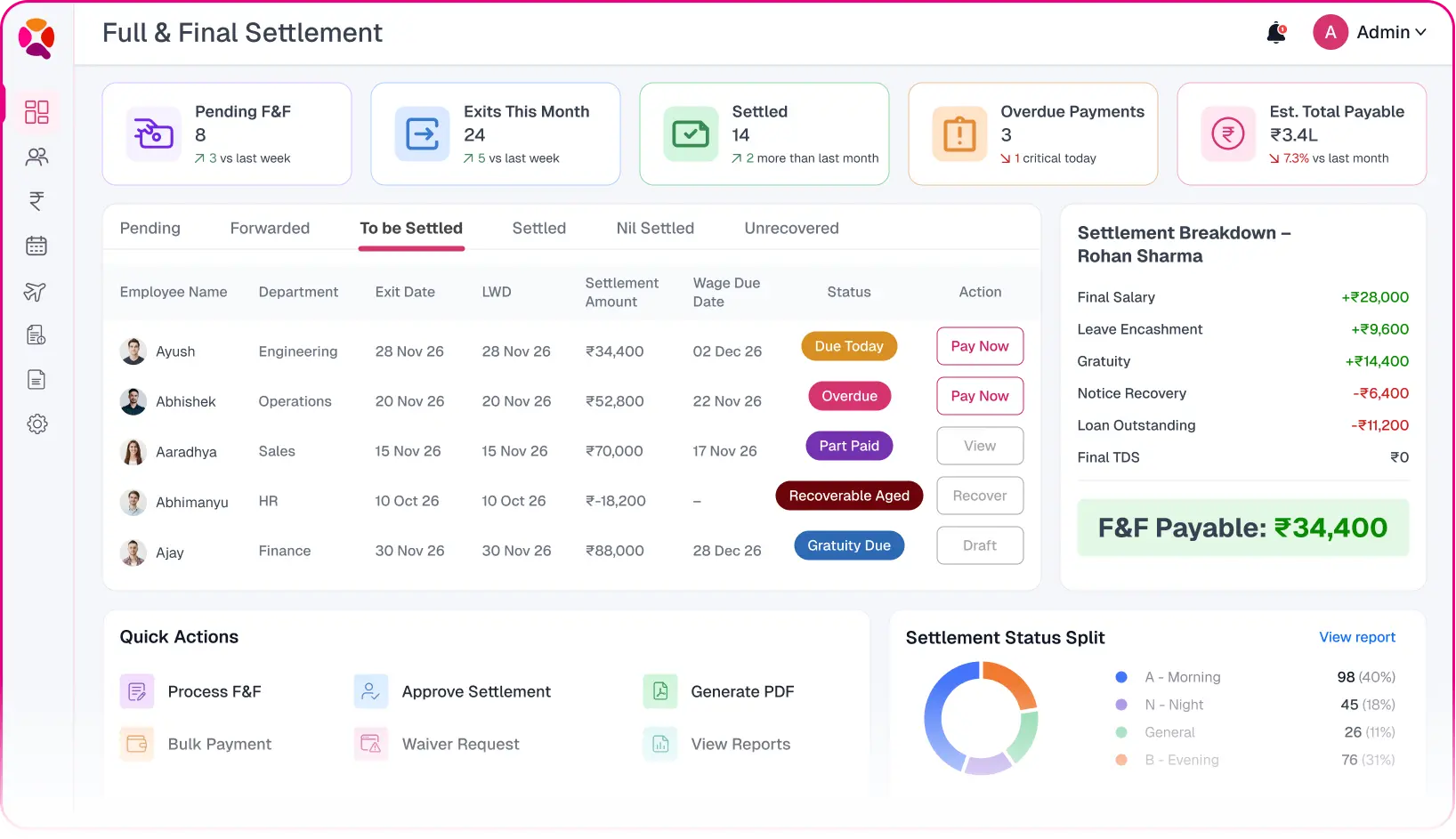
QkrHR works out what the company owes a leaving employee and what they owe back, nets it to one amount, and tracks it until it is paid or recovered. Salary, leave, gratuity, loans, expenses and assets come in from their own modules, and the wage due date is on the settlement from day one.
What Is a Full and Final Settlement?
A full and final settlement (F&F) is the last payroll calculation for an employee who leaves. It adds up everything the company still owes them, subtracts everything they still owe the company, and arrives at one figure: payable to the employee if positive, recoverable from them if negative.
In QkrHR the settlement has twelve components. Most are pulled in from payroll, leave, loans and expenses. Only the judgement calls are typed by HR: notice shortfall, waiver, leave encashment and asset deductions.
How the Sign Decides
Payable or Recoverable
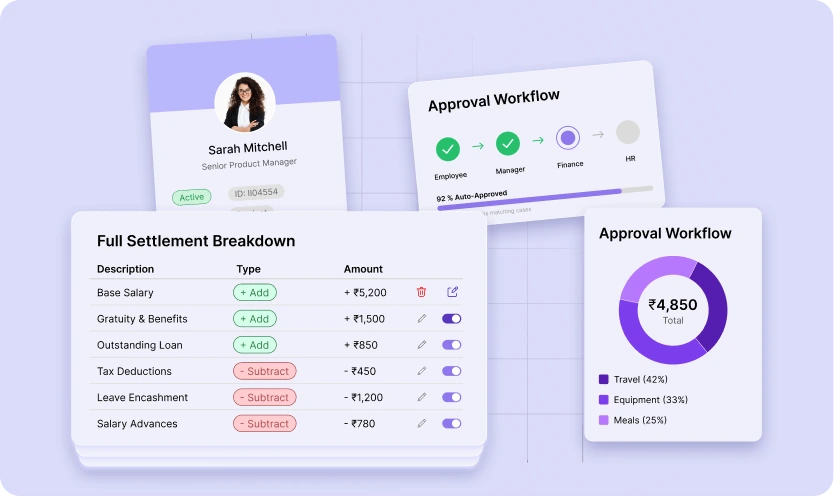
The same settlement can go either way. Change the loan balance below and watch the total flip, the way the banner does on every edit inside QkrHR.
F&F
recoverable
₹44,000
The employee owes the company. QkrHR moves it to To be Settled as Recoverable and tracks its age until it is recovered.
The Full and Final Settlement Process,
Step by Step
A settlement starts on its own on the employee's last working day. QkrHR moves it through four stages, and the F&F next steps view tells each person what is waiting on them.
- Step 01
Close the salary months
Lock the leaving month's attendance and finalise its salary, along with any earlier month still open. The settlement pays the final salary, so that salary has to exist first.
- Step 02
Run the pre-check
Open expense reports, advance requests and travel bookings stop the settlement until they are cleared. Assets still held and approvals still routed to the leaver are listed too.
- Step 03
Process, approve, publish
Save a draft, forward it through your F&F approval workflow, then publish. Without a workflow, publish directly. The sign decides Payable or Recoverable.
- Step 04
Settle
Record the payment or recovery, in full or in parts. Then issue the relieving letter from the exit record.
A Pre-Check That Stops Double Payments
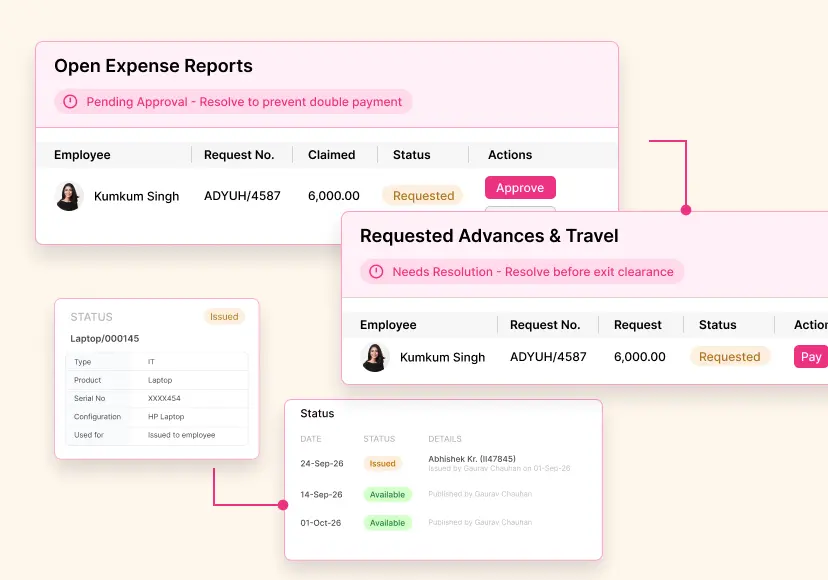
Most F&F errors come from something still open elsewhere: an expense report nobody approved, an advance never paid, a booking left hanging. QkrHR checks for these before the settlement opens and lists exactly what to clear.
- Open expense reports must be approved or rejected first, so a claim is never reimbursed twice.
- Requested advances must be paid or rejected, and travel bookings marked booked or cancelled.
- Company assets the employee still holds are shown, ready to recover as an asset deduction.
- Approvals still routed to the leaver are listed, so their requests can be reassigned and keep moving.
Notice Period Recovery and Waivers With a Paper Trail
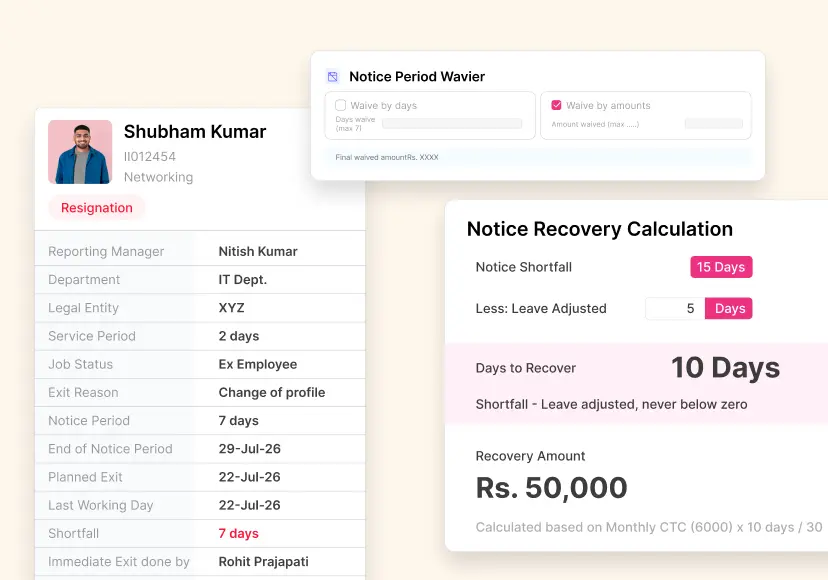
When someone leaves before serving full notice, QkrHR takes the shortfall from the exit record and charges it at their monthly CTC. HR decides how much leave to adjust against it, and any waiver needs a name and a reason.
- Days recovered = notice shortfall − leave adjusted, never below zero.
- Recovery = monthly CTC × days recovered ÷ 30.
- Waive by days or by a fixed amount. The waiver is refused at save without an authoriser and remarks.
- Attach the approval email that authorised the waiver to the settlement itself.
Leave Encashment That Always Adds Up to Zero
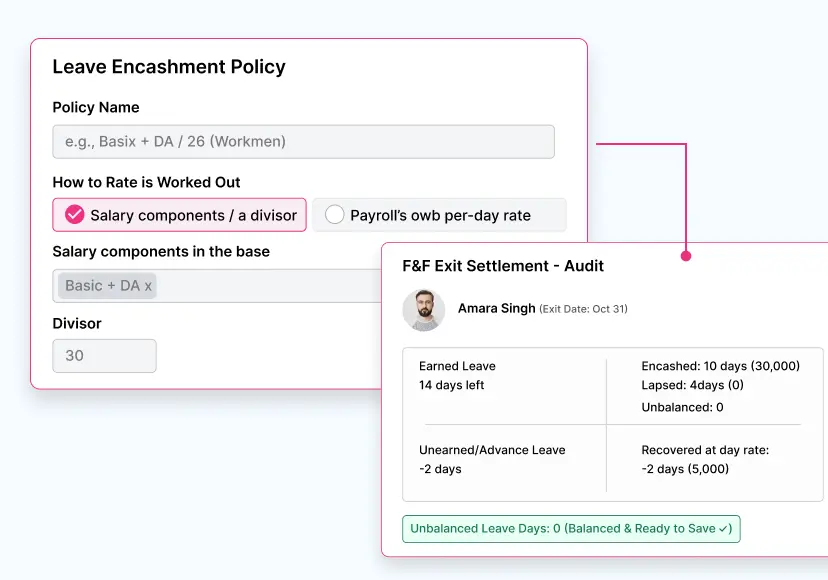
Every leave day left at exit has to go somewhere. In QkrHR it is either encashed or lapsed, and the settlement will not save until each leave type balances to zero. Leave taken before it was earned is settled on its own line.
- The day rate comes from your leave encashment policy, so F&F, year end and ad hoc encashment value a day the same way.
- If the policy has no answer, QkrHR falls back to (Basic + DA) ÷ 30 and says so on the screen, instead of blocking the settlement.
- Up-front yearly credit not yet earned, and leave given in advance, are recovered at the same day rate.
- Leave types that don't recover unearned leave are written off in days, with no money charged.
Gratuity Calculated Under the Labour Codes, Formula Shown
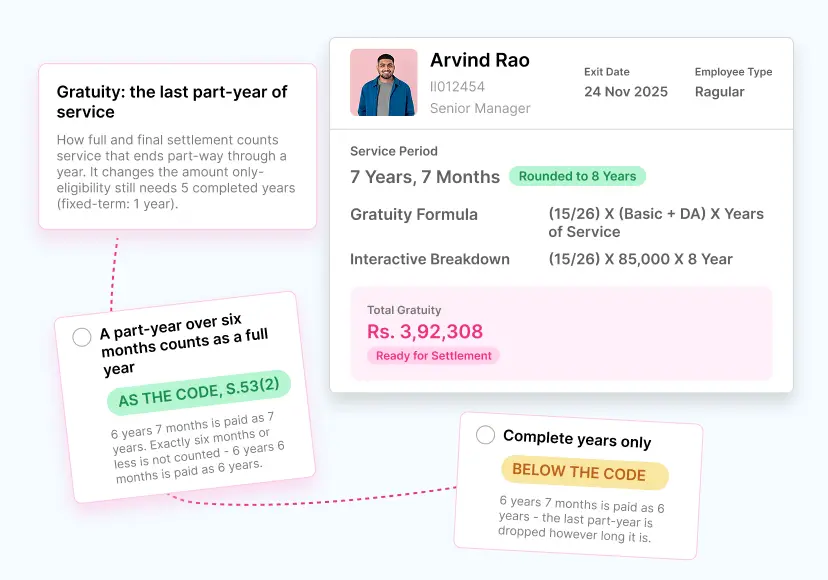
Gratuity is where most F&F disputes start, so QkrHR puts the working on the settlement: the service period, the formula in force and the amount it produced. Anyone checking later can see exactly how the figure was reached.
- For exits on or after 21 November 2025, the rate is last drawn wages under the Code on Social Security, 2020, never below Basic + DA.
- Earlier exits use Basic + DA, as before.
- Fixed-term employees qualify after one year of service instead of five.
- Whether a final part year over six months counts as a full year is set per legal entity, with a visible note when it differs from the Code.
The Two-Day Wage Deadline, Tracked on Every Settlement
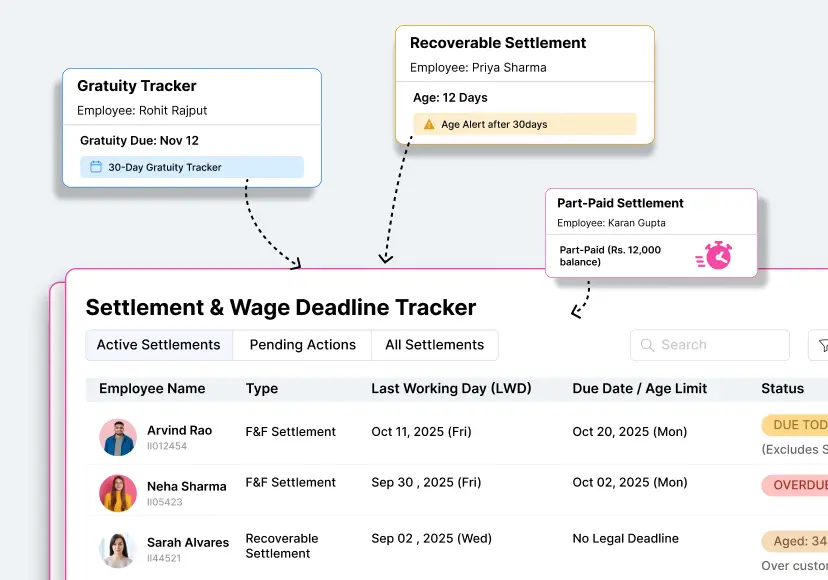
Under the Code on Wages, wages on separation are due within two working days. QkrHR counts that date from the last working day, skipping Sundays and the employee's location holidays, and shows it on the settlement and in Pending Actions.
- The due date turns amber when due and red when overdue.
- Gratuity carries its own 30-day due date.
- A recoverable settlement has no legal deadline, so QkrHR shows its age instead and marks it aged after a limit you set, 30 days by default.
- The clock keeps running on a part-paid settlement until the balance is cleared.
Pay, Recover or Close, With Every Status Recorded
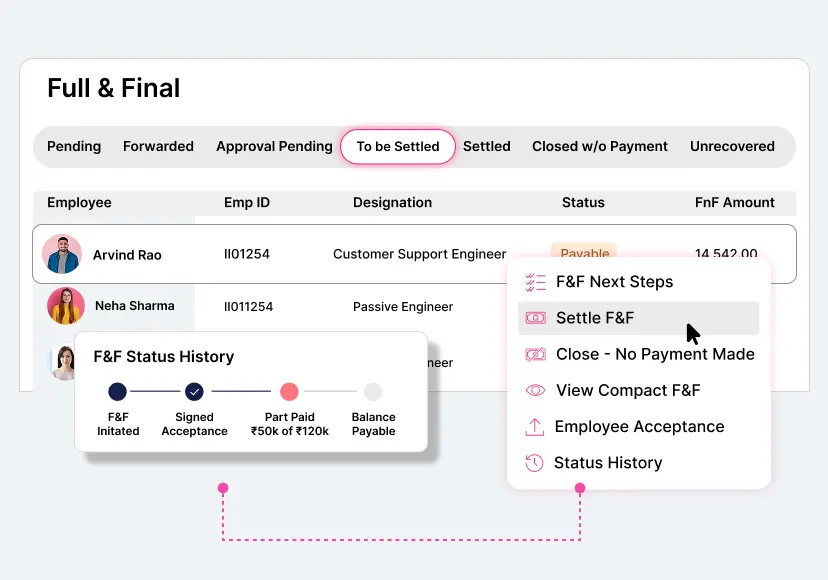
Real exits don't always end in one clean payment. QkrHR handles part payments, bulk payouts, signed acceptance and the cases where money never changes hands, and keeps a status history of who did what.
- Part payments: pay ₹50,000 of ₹1,20,000 now and the balance stays open as Part Paid.
- One voucher, many employees: pay several settlements of a legal entity together, without paying anyone twice.
- Signed acceptance: require the employee's signed acceptance before final payment, by policy.
- Close without payment for absconding employees, mark unrecovered when money won't come back, and revert if they later agree to pay.
- A one-page compact F&F downloads as PDF for the employee or the auditor.
Every Settlement Has a Status
You Can See
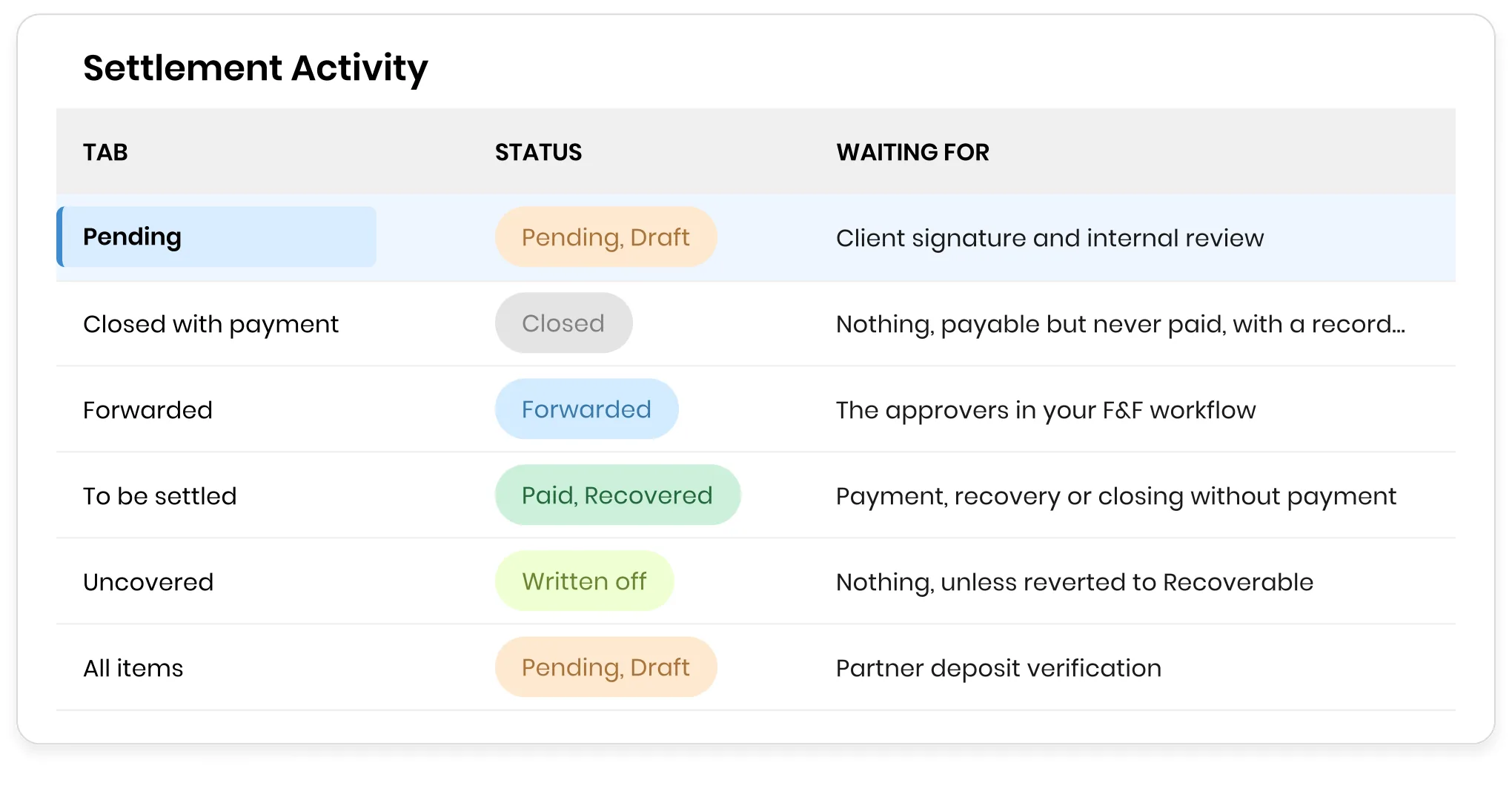
The Full & Final page in QkrHR is organised by status. Each tab is a queue of settlements waiting on the same kind of step, so nothing sits unnoticed.
Full and Final Settlement Rules
Under India's Labour Codes
The Labour Codes took effect on 21 November 2025. For many companies, the biggest change at exit is time: the 45 to 60 days that settlements used to take no longer fits the law for the wage part of the F&F.
2 Days
Wages on separation
Wages due to an employee who resigns, is removed, dismissed or retrenched are payable within two working days of the separation.
Code on Wages, 2019, Section 17(2)30 Days
Gratuity payment
Where gratuity applies, it is payable within 30 days of becoming due, with interest on any delay.
Code on Social Security, 2020, Chapter V1 Year
Fixed-term gratuity
Fixed-term employees qualify for pro rata gratuity after one year of service, instead of the five years that apply to permanent staff.
Code on Social Security, 2020, Section 53This is a summary, not legal advice.
Simplifying Employee Exits with QkrHR

One live total
The banner recalculates on every edit and shows Payable or Recoverable as you work.

Pulled in, not retyped
Salary, claims, advances and loans come from their own modules. Fix the source, not the settlement.

Errors blocked at save
Unbalanced leave, an incomplete waiver or a half-filled deduction line won't save.

Deadlines in view
Wage and gratuity due dates, and the age of every recovery, in Pending Actions.

Labour Code ready
Two-day wage dates, gratuity on Code wages and fixed-term eligibility are built in.

Audit-ready records
Status history, attachments for every waiver and deduction, and a compact F&F PDF.
Run One of Your Settlements in QkrHR
Bring a recent exit with its notice, leave and loan details. We'll calculate the full and final settlement with you in the demo, on your own policies.